
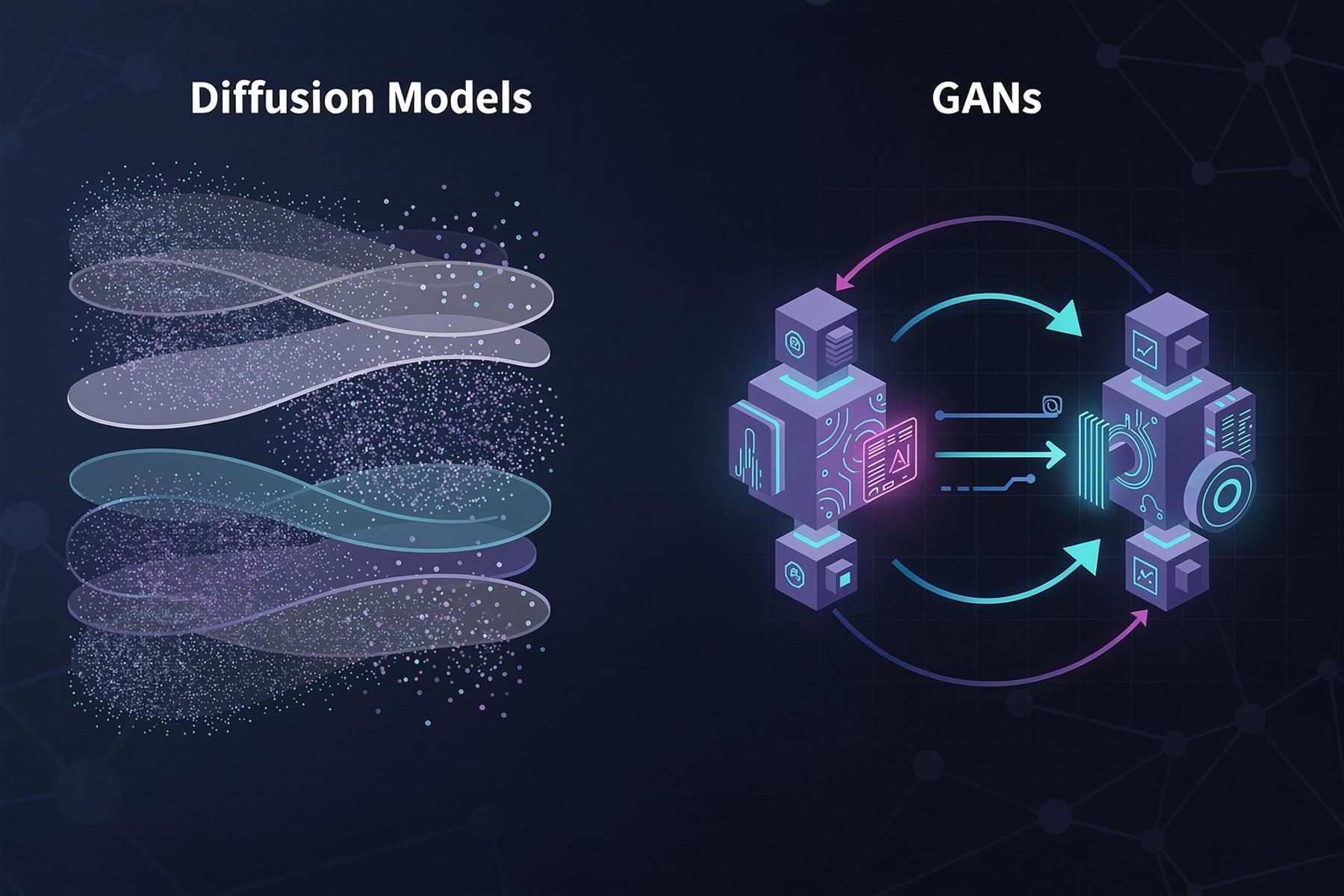
Diffusion Models vs GANs: Key Differences Explained
Explore the fundamental differences between diffusion models and GANs, two leading AI image generation technologies, and how to detect their outputs.
Introduction to AI Image Generation Technologies
Artificial intelligence has revolutionized digital imagery, enabling the creation of highly realistic visuals from simple text prompts. Two dominant technologies powering this transformation are Generative Adversarial Networks (GANs) and Diffusion Models. While both can produce stunning AI-generated content, they operate on fundamentally different principles. Understanding these differences is crucial for professionals in content verification, journalism, and digital media who rely on tools like Detect AI Image to ensure image authenticity.
This article explores the key distinctions between diffusion models and GANs, their strengths and limitations, and practical implications for detecting AI-generated images.
How GANs Work: The Adversarial Approach
Generative Adversarial Networks, introduced by Ian Goodfellow in 2014, consist of two neural networks locked in competition:
- Generator: Creates images from random noise, aiming to produce realistic outputs
- Discriminator: Evaluates images, distinguishing between real and generated examples
Key Characteristics of GANs
- Adversarial Training: The generator improves by fooling the discriminator, while the discriminator becomes better at detection
- Fast Generation: Once trained, GANs can produce images in a single forward pass
- Mode Collapse: May produce limited variety in outputs, focusing on “safe” examples that fool the discriminator
- Training Instability: Requires careful balancing between generator and discriminator
Practical Examples of GANs
- StyleGAN: Used for generating highly realistic human faces (e.g., ThisPersonDoesNotExist.com)
- CycleGAN: Transforms images between domains (e.g., turning horses into zebras)
- Pix2Pix: Converts sketches into photorealistic images
GAN-generated images often exhibit subtle artifacts like:
- Unnatural textures in backgrounds
- Asymmetrical facial features
- Blurry or distorted fine details
Diffusion Models: The Gradual Denoising Process
Diffusion models, popularized by research from OpenAI and Google in 2020-2021, take a fundamentally different approach:
- Forward Process: Gradually adds noise to an image until it becomes pure random noise
- Reverse Process: A neural network learns to reverse this noise addition, reconstructing images from noise
Key Characteristics of Diffusion Models
- Iterative Generation: Produces images through many small denoising steps (typically 25-1000)
- Stable Training: More predictable than GANs, with less risk of mode collapse
- High-Quality Outputs: Often produces more detailed and diverse images
- Computationally Intensive: Requires more resources during both training and generation
Practical Examples of Diffusion Models
- Stable Diffusion: Open-source model capable of generating diverse image types
- DALL-E 2: OpenAI’s model for creating images from text descriptions
- Imagen: Google’s text-to-image diffusion model
Diffusion model outputs may show:
- Overly smooth textures in some areas
- Inconsistent details when zoomed in
- Artifacts in complex compositions
Key Differences Between Diffusion Models and GANs
| Feature | Diffusion Models | GANs |
|---|---|---|
| Training Approach | Gradual denoising process | Adversarial competition |
| Generation Speed | Slower (many iterative steps) | Faster (single forward pass) |
| Training Stability | More stable, predictable | Less stable, requires careful balancing |
| Output Quality | Generally higher quality, more diverse | Can be high quality but prone to artifacts |
| Resource Usage | Computationally intensive | Less resource-intensive |
| Mode Coverage | Better at covering diverse outputs | Prone to mode collapse |
| Flexibility | Easier to adapt to new tasks | Requires architecture adjustments |
Detecting AI-Generated Images from Different Models
As AI image generation advances, distinguishing between real and synthetic content becomes more challenging. However, each model leaves unique fingerprints that tools like Detect AI Image can identify:
GAN Detection Characteristics
- Texture Inconsistencies: Unnatural patterns in backgrounds or surfaces
- Facial Asymmetry: Subtle mismatches in eyes, ears, or facial features
- Artifact Patterns: Repeating patterns or blurry areas
- Color Distribution: Unnatural color gradients or saturation
Diffusion Model Detection Characteristics
- Over-Smoothing: Some areas appear too smooth or plastic-like
- Detail Inconsistencies: Fine details may not align perfectly
- Composition Issues: Complex scenes may have logical inconsistencies
- Lighting Artifacts: Unnatural shadows or reflections
Practical Detection Tips
- Examine Fine Details: Zoom in on textures, hair, or fabric patterns
- Check Symmetry: Look for asymmetrical features in faces or objects
- Analyze Backgrounds: AI-generated backgrounds often contain artifacts
- Verify Context: Does the image make logical sense in its composition?
- Use Detection Tools: Combine manual inspection with tools like Detect AI Image for comprehensive verification
Practical Applications and Industry Impact
Journalism and Media Verification
Journalists increasingly rely on AI detection tools to:
- Verify user-submitted content on social media
- Authenticate images in breaking news situations
- Identify potential deepfakes in political or sensitive contexts
“In an era of misinformation, tools that can distinguish between real and AI-generated images are essential for maintaining journalistic integrity,” notes Sarah Chen, Digital Editor at Global News Network.
Academic Integrity
Educational institutions use AI detection to:
- Verify student artwork submissions
- Detect AI-generated images in research papers
- Maintain academic honesty in digital media courses
Content Creation and Copyright
Content creators and marketers benefit from:
- Verifying the origin of stock images
- Ensuring proper attribution for AI-generated content
- Protecting original work from unauthorized AI training
The Future of AI Image Generation and Detection
As both generation and detection technologies evolve, we can expect:
- More Sophisticated Models: Future AI generators will produce even more realistic images
- Improved Detection: Tools like Detect AI Image will enhance their algorithms to keep pace
- Regulatory Developments: Potential requirements for AI-generated content labeling
- Hybrid Approaches: Combining the strengths of diffusion models and GANs
Researchers are also exploring:
- Watermarking Techniques: Embedding invisible markers in AI-generated images
- Metadata Standards: Developing protocols for AI content identification
- Collaborative Detection: Community-driven approaches to identifying AI artifacts
Best Practices for Image Verification
- Combine Multiple Methods: Use both manual inspection and automated tools
- Check Image Metadata: Look for AI-related metadata or inconsistencies
- Reverse Image Search: Verify if the image appears elsewhere online
- Consider the Source: Evaluate the credibility of the image provider
- Use Specialized Tools: Leverage platforms like Detect AI Image for comprehensive analysis
- Stay Informed: Keep up with advancements in AI image generation
- Contextual Analysis: Consider whether the image makes logical sense
Conclusion
While both diffusion models and GANs produce impressive AI-generated content, their underlying mechanisms lead to distinct characteristics in their outputs. Diffusion models generally offer higher quality and more diverse images but require more computational resources, while GANs provide faster generation at the potential cost of some output quality and variety.
For professionals in journalism, education, and content creation, understanding these differences is crucial for effective image verification. Tools like Detect AI Image play a vital role in maintaining digital authenticity by identifying the subtle artifacts left by different AI generation techniques.
As AI image generation continues to advance, staying informed about these technologies and their detection methods will be essential for anyone working with digital imagery. Whether you’re verifying news photos, assessing student submissions, or creating original content, the ability to distinguish between real and AI-generated images remains a critical skill in the digital age.